
Quick Summary
Commercial facilities require sophisticated pedestrian access solutions that maintain strict perimeter security while eliminating peak-hour lobby bottlenecks. Motorized speed turnstiles solve this challenge through synchronized optical sensors and low-latency credential verification, with commercial specialists like Absolute Gate Repair Solutions providing the precise calibration and system integration required for maximum throughput. Readers will gain a clear understanding of speed gate mechanisms, architectural configuration options, installation requirements, and the maintenance practices needed to ensure long-term lobby safety and efficiency.
Speed Turnstile: Secure Fast Lobby Access With Zero Delays
A commercial speed turnstile balances physical perimeter security with rapid, unhindered foot traffic for busy corporate lobbies. For property managers and security directors, managing pedestrian flow without creating morning entry bottlenecks requires precise coordination between barrier hardware, optical sensors, and access credentials.[5]
With the global speed gate market estimated at USD 1,889.56 million in 2025 and projected to grow at a 7.8% CAGR through 2035, facilities are increasingly moving away from legacy mechanical barriers in favor of motorized optical lanes. According to technical advisors like Absolute Gate Repair Solutions, achieving steady pedestrian flow requires synchronized sub-assemblies, properly balanced safety beams, and low-latency reader hardware to keep lobby access secure and moving efficiently.[1]
What Is a Speed Turnstile and How Does It Work?
Speed gates represent a turnstile category used extensively in modern access control, with optical turnstiles serving as a major segment. A speed turnstile typically uses motorized glass or acrylic barrier wings paired with an array of optical sensors embedded along the lane cabinet. When an authorized user presents a valid credential, the lane controller verifies authorization and opens the barriers. Once the pedestrian clears the passage, sensor curtains confirm the user has passed through and close the barriers to prevent unauthorized followers.[2]
Core Components of Modern Electronic Turnstile Gates
Unlike basic mechanical tripods, automated speed gates rely on several synchronized sub-assemblies to maintain security:
- Drive Motors: Provide smooth, quiet wing movement and handle continuous duty cycles during peak arrival times.
- Optical Sensor Curtains: Monitor the lane footprint to track pedestrian movement, account for rolling bags, and flag tailgaters trying to slip through on a single scan.
- Logic Controllers: Coordinate wing movement, process credential relays, and trigger safety reversals if an obstruction enters the swing path.
Key Benefits for Commercial Property Access
For facility managers, upgrading to motorized optical turnstiles delivers distinct operational advantages:
- Fast Pedestrian Flow: Minimizes lobby congestion by authenticating and passing authorized personnel rapidly.
- Access Control Integration: Connects with standard credential systems, including RFID readers, mobile systems, barcode scanners, and biometric devices.
- Active Tailgate Prevention: Emits alarms and signals security systems when an unauthorized individual follows closely behind a valid credential holder.
Speed Turnstiles vs. Standard Optical and Tripod Gates
Selecting the right pedestrian access system depends on balancing physical security, processing speed, and lobby aesthetics. Traditional waist-high tripod turnstiles create physical barriers but can slow down high-volume crowds. Barrier-free optical lanes allow fast movement but rely on alarms and staff intervention to stop unauthorized entry. A motorized speed turnstile combines physical deterrence with high throughput while maintaining an open, modern architectural look.
Comparing Physical Security, Throughput, and Aesthetics
| Feature | Tripod Turnstile | Barrier-Free Optical | Speed Turnstile |
|---|---|---|---|
| Physical Security | Medium (Waist-high metal arms) | Low (Alarm notification only) | High (Motorized barrier wings) |
| Throughput Speed | Basic mechanical flow | Open, barrier-free flow | Designed for high-traffic environments and faster flow than basic mechanical barriers |
| Tailgate Prevention | Mechanical rotation lock | Audible sounder only | Active sensor array with physical barrier |
| Architectural Finish | Industrial / Utility | Minimalist bollards | Brushed stainless steel and architectural glass |
High-profile commercial properties routinely implement motorized speed lanes to match enterprise design standards while enforcing clear access control boundaries. The real-world success of these systems depends on precise sensor calibration alongside barrier opening speed.
Accessible and Wide-Lane Configurations
To accommodate accessibility requirements, modern speed turnstile product lines can be deployed with standard lanes alongside wider accessible passages within matching cabinet designs. This provides accessible entry for wheelchairs, delivery carts, and luggage while maintaining a consistent visual aesthetic across lobby entry points.
Why Real-World Throughput Differs From Manufacturer Ratings
Speed turnstiles are designed for high-traffic environments and faster flow than basic mechanical barriers. However, practical throughput in active commercial settings often differs from theoretical cycle ratings. Laboratory ratings typically measure continuous mechanical cycle speed, whereas operational lobbies must accommodate human walking patterns, badge presentation times, and optical sensor validation.
Sensor Array Recalibration vs. Barrier Wing Speed
Throughput drops when infrared sensors misinterpret rolling luggage, large personal items, or environmental lighting as tailgating violations. When sensors are improperly tuned, the lane triggers false alarms and halts barrier movement. Properly calibrating optical emitter-receiver grids ensures that light curtains distinguish personal items from unauthorized followers without compromising security.
Credential Latency in High-Volume Commercial Lobbies
Pedestrian flow can stall if an access controller experiences processing delays. To maintain optimal throughput, facilities focus on low-latency credential processing:
- Select Rapid Card Readers: Install readers that quickly process credentials upon presentation.
- Position Reader Targets Ergonomically: Angle credential readers near the front edge of the cabinet so pedestrians scan before breaking their natural walking stride.
- Optimize Controller Architecture: Process access decisions efficiently through localized control panels to avoid network latency during peak hours.
Speed Turnstile Cost and Commercial Installation Breakdown
Total project costs for speed turnstile systems vary based on hardware choice, cabinet finishes, architectural specifications, and integration requirements. Total expenditure is typically influenced by the number of lanes, barrier height, width options, and specific infrastructure preparations.
Hardware and Lane Configuration Variables
| Lane Configuration | Barrier Style & Passage Type | Primary Cost Drivers |
|---|---|---|
| Standard Pedestrian Lane | Standard height / Standard passage width | Stainless steel pedestal, barrier wings, standard optical array |
| Accessible Lane | Standard height / Wide clear passage | Wider barrier wings, extended optical sensor arrays, reinforced drive mechanisms |
| High-Security Glass Lane | Full-height barrier panels | High-torque drive motors, extended glass panels, reinforced structural anchoring |
Site Preparation, Power, and Access Control Wiring Requirements
As security specialists at Absolute Gate Repair Solutions note, professional turnstile installation involves several essential infrastructure considerations:
- Conduit and Cabling Pathways: Routing low-voltage communication lines and power circuits through floor pathways or slab cores.
- Power Supply Configuration: Supplying appropriate regulated power to support internal logic boards, sensor arrays, and motorized drives.
- Life Safety and Fire Relays: Connecting emergency relays to open or release barriers during building evacuations in accordance with facility safety plans.
Maintenance Protocols, Safety Features, and Emergency Fail-Safes
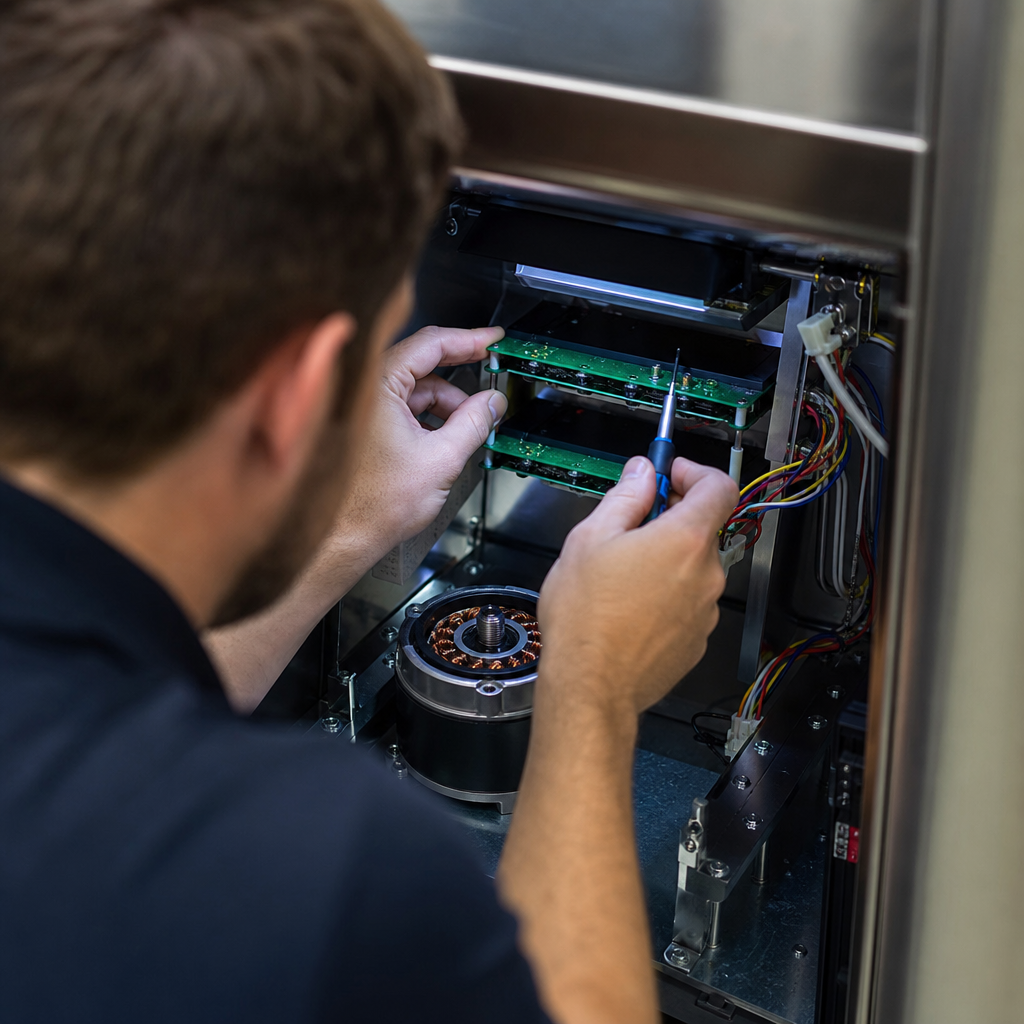
Consistent preventive maintenance keeps speed turnstiles operating smoothly and helps prevent component wear. High-traffic commercial properties place regular mechanical demands on drive components and optical assemblies. A structured maintenance schedule, frequently recommended by Absolute Gate Repair Solutions, helps prevent false alarms, ensures proper alignment, and verifies that emergency releases function correctly.
Optical Sensor Maintenance and Mechanical Diagnostics
Facility maintenance teams should conduct regular inspections across three main areas:
- Sensor Cleaning and Alignment: Keep optical sensors clear of dust and debris, and confirm optical alignment across the lane.
- Drive Mechanism Inspection: Check motor assemblies and drive components for smooth operation and appropriate mechanical tension.
- Safety Reversal Tests: Verify that barrier wings reverse motion when encountering resistance, protecting pedestrians from impact.
Emergency Release and Power-Loss Operations
Speed turnstiles are designed with fail-safe features to support emergency egress. When primary power is lost or an emergency alarm system triggers, the barrier mechanisms can release or open, allowing unhindered egress through the lane.
Frequently Asked Questions About Speed Turnstiles
How do speed turnstiles integrate with commercial access control systems?
Speed turnstiles connect to commercial access control systems via standard relay outputs, Wiegand, or OSDP communication lines. They accept authorization signals from credential readers and report passage confirmations back to the security management software.[4]
What is the difference between standard turnstiles and optical speed gates?
Standard tripod turnstiles use mechanical rotating arms that require physical contact to push through. Speed gates are an access control turnstile category, often featuring optical sensor arrays and motorized barrier wings, that provide automated passage, faster movement, and a modern aesthetic.[3]
How much does it cost to purchase and install speed turnstiles?
Costs vary depending on cabinet materials, security barrier heights, passage widths, and installation requirements such as floor coring, power delivery, and access control integration.
What safety mechanisms prevent speed turnstile barriers from closing on pedestrians?
Speed turnstiles use integrated safety optical sensors that continuously monitor the passage area. If an obstruction is present in the barrier path, the controller inhibits closure. In addition, drive systems include torque-sensing features that reverse wing movement if contact occurs.
How many people per minute can pass through a speed turnstile lane?
Speed turnstiles are designed for high-traffic environments and faster flow than basic mechanical barriers. In practical operation, throughput depends on pedestrian movement, credential presentation speed, and sensor validation rather than theoretical cycle ratings alone.
What maintenance do automatic speed turnstiles require?
Routine service includes cleaning and aligning optical sensors, inspecting drive mechanisms, checking electrical connections, and testing emergency release functionality to ensure safe and reliable operation.
Sources
- Global Speed Gate Market Projected to Grow at an 7.8% CAGR, Reaching USD 4,004.51 million by 2035 – openpr.com (2035)
- Half and Full Height Turnstiles Market Size, Growth | Industry Report … – marketgrowthreports.com (2035)
- Turnstile Gates & Access Control Market Size 2026-2032 – 360iresearch.com (2032)
- Turnstiles Access Control System Market Size & Growth 2035 – marketresearchfuture.com (2035)
- Turnstile Access Control Market Research Report 2033 – Dataintelo – dataintelo.com (2034)
Related reading: Turnstile Gate | Call Now-10% Off | Same-Day Service | Free Estimate
Related reading: Access Doorking Com | Call Now-10% Off | Same-Day Service | Free Estimate
Related reading: Access Doorking – Call Now-10% Off – Same-Day Service – Free Estimate
Frequently Asked Questions
Can speed turnstiles be installed on existing lobby floors without heavy structural alterations?
Yes, speed turnstiles can be retrofitted onto existing finished floors using precision core drilling or low-profile floor raceways for power and data lines. Commercial access experts like Absolute Gate Repair Solutions assess subfloor conditions to ensure secure anchoring and clean wire routing with minimal disruption.
How do speed turnstiles react during a facility fire alarm or total power outage?
Speed turnstiles connect directly to the building fire alarm panel through dedicated emergency relays. During an active alarm or power failure, the fail-safe motorized barrier wings automatically release or swing open to provide unimpeded evacuation routes.
How are speed turnstiles configured to meet ADA accessibility requirements?
Lobbies typically pair standard turnstiles with wide-lane configurations providing at least 32 to 36 inches of clear passage for wheelchairs, mobility devices, and deliveries. Absolute Gate Repair Solutions can integrate matching wide-passage cabinets so accessible lanes blend seamlessly with standard security lanes.
About the author
 |
Sarah Miller Sarah Miller is a specialized content writer focusing on residential and commercial security infrastructure, with a particular interest in access control systems. She holds a B.A. in Communications from California State University, Northridge and has spent the last four years writing technical yet accessible guides for property managers and homeowners in Southern California. Her work highlights practical maintenance strategies and the importance of reliable emergency repair services. |