
Quick Summary
Selecting the right commercial turnstile gate requires balancing physical security needs, pedestrian flow rates, and life-safety compliance across interior and perimeter access points. Matching specific barrier types – such as optical units for high-traffic lobbies or full-height turnstiles for perimeter security – with integrated credential readers ensures efficient entry management and dependable emergency egress. Readers will gain clear guidance on system selection and compliance, enabling them to schedule a free consultation with Absolute Gate Repair Solutions for commercial turnstile gate installation, integration, and repair services.
Turnstile Gate Installation & Repair: Fast Secure Access
When you need reliable turnstile gate installation, access control integration, or mechanical repair, selecting equipment that withstands daily traffic is essential. From waist-high mechanical tripod barriers to optical turnstiles and full-height perimeter gates, choosing the right entry hardware keeps pedestrian traffic moving while protecting your property.[1]
Managing facility access means balancing physical security with accessibility and life-safety guidelines. Whether upgrading a corporate lobby or securing an exterior perimeter, professional installation ensures credential readers and safety overrides work together reliably.[2]
Turnstile Gate Overview: Costs and System Options
Turnstile Gate Overview: Turnstile gate options range from basic waist-high tripods and aesthetic optical turnstiles for busy lobbies to full-height barriers for maximum perimeter defense. Proper installation, as recommended by specialists like Absolute Gate Repair Solutions, pairs hardware with access controllers, accessible entry points, and emergency release overrides.[3]
Selecting the right pedestrian barrier depends on your daily foot traffic, perimeter location, and facility security requirements.
Core Investment Snapshot
Turnstile hardware serves distinct functions across different facility zones. Optical turnstiles handle interior checkpoints where aesthetic integration and high-speed pedestrian processing matter most, while full-height turnstiles provide ultra-secure perimeter defense for fence lines and exterior areas.
| System Type | Primary Application | Security Profile |
|---|---|---|
| Tripod Turnstile | Transit stations, gyms, and basic checkpoints | Medium Deterrent |
| Optical Turnstile | Corporate lobbies and monitored entryways | High-Speed Monitored Flow |
| Full-Height Turnstile | Industrial yards and high-security fence lines | Ultra-Secure Perimeter Defense |
Essential Decision Criteria for Commercial Properties
Setting up access gates requires balancing throughput speed with physical durability. Commercial turnstiles must process credentials smoothly while integrating with emergency release systems during power outages or alarm activations.
Commercial Turnstile Gate Types: Optical vs. Full-Height Barriers
The right commercial turnstile gate depends on security goals, aesthetic preferences, and pedestrian volume. Optical turnstiles provide fast, seamless clearance for interior lobbies, while full-height turnstiles deliver ultra-secure perimeter protection.[4]
| Feature | Tripod Turnstile | Optical Turnstile | Full-Height Turnstile |
|---|---|---|---|
| Security Level | Medium (Deterrent) | Medium-High (Monitored) | Maximum (High-Security) |
| Throughput Focus | Standard volume | High-speed flow | Controlled single entry |
| Primary Use Case | Gyms & Transit | Corporate Lobbies | Perimeter Fence Lines |
| Access Integration | Mechanical or electronic | Sensor and barrier arrays | Full-cage perimeter lock |
Tripod Turnstiles
Tripod turnstiles are a durable, economical choice for high-volume entry points such as transit stations and fitness facilities. These mechanical or semi-automatic barriers process standard pedestrian volumes effectively through single-turn rotation.
Optical Turnstiles
Optical turnstiles feature sleek barrier designs and sensor arrays to provide aesthetic integration and high-speed pedestrian processing. These units are ideal for modern corporate lobbies and monitored indoor environments where architectural design and rapid badge scanning are primary priorities.
Full-Height Turnstiles
For exterior boundaries and high-security areas, full-height turnstiles provide floor-to-ceiling physical barriers designed for ultra-secure perimeter use. Standard turnstiles are not wheelchair accessible, so an accessible entry point is required alongside them.[5]
Accessibility and Egress Considerations
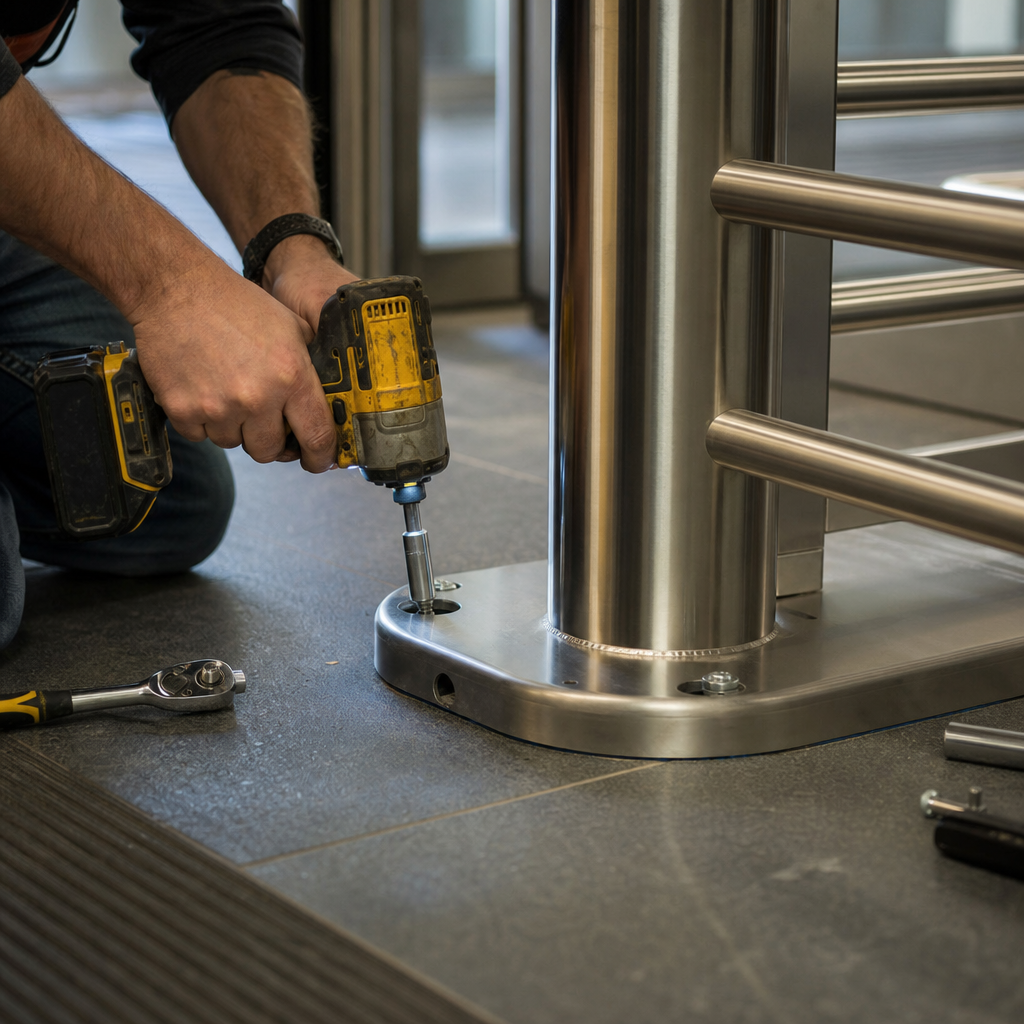
Turnstile installations must account for facility accessibility and safe egress. Emergency systems require appropriate fail-safe or fail-secure operation depending on the site application.
Accessibility Requirements
Standard turnstiles are not wheelchair accessible. To ensure accessibility for all individuals, an accessible entry point is required alongside the turnstile installation.
Emergency Egress Mechanisms
In emergency situations, turnstile systems must support rapid egress. Optical turnstiles and drop-arm mechanical units can be configured to clear the entry path automatically when an alarm activates or power is lost.
Fail-Safe vs. Fail-Secure Mechanisms
| Configuration | Power Loss Behavior | Primary Application | Compliance Focus |
|---|---|---|---|
| Fail-Safe | Rotor or barrier unlocks freely | Lobbies and primary indoor exit paths | Life safety and emergency egress |
| Fail-Secure | Mechanism stays locked | Exterior perimeter fences and secure storage | Maintains physical security perimeter |
Turnstile Gate Installation, Access Integration, and Service
Turnstile systems connect physical barriers with electronic access controls to maintain security and streamline pedestrian traffic.
Integrating Access Controllers
Turnstiles connect with credential systems such as RFID proximity card readers, mobile credentials, and biometric scanners, which technicians at Absolute Gate Repair Solutions configure for seamless facility access. These integrations enable real-time event logging and centralized entry management.
Turnstile Maintenance and Repairs
Routine inspection and servicing ensure mechanical components, sensors, and electronic controls operate smoothly, helping prevent pedestrian bottlenecks and equipment downtime.
Frequently Asked Questions About Turnstile Gate Services
How much does a turnstile gate cost to buy and install?
Turnstile equipment and installation costs vary depending on the system type and site conditions. Tripod turnstiles generally offer the most budget-conscious entry point, full-height turnstiles represent a mid-to-high investment for perimeter security, and optical turnstiles represent a premium tier for interior spaces. Final pricing depends on site preparation, conduit needs, and access control integration.
What are the different types of turnstile gates available?
The primary types of turnstiles are tripod turnstiles, optical turnstiles, and full-height turnstiles, each suited for different security levels, aesthetic demands, and traffic volumes.
How do optical turnstiles differ from full-height turnstiles?
Optical turnstiles emphasize aesthetic integration and high-speed pedestrian processing in monitored indoor environments, whereas full-height turnstiles emphasize ultra-secure perimeter use with full floor-to-ceiling physical deterrence.
Can turnstile gates integrate with card readers and biometric access control?
Yes. Commercial turnstiles integrate with credential readers including RFID badges, key fobs, mobile credentials, and biometric authentication devices.
Are turnstile gates ADA compliant?
Standard turnstiles are not wheelchair accessible. To maintain accessibility, an accessible entry point is required in conjunction with the turnstile installation.
What maintenance do commercial turnstile gates require?
Commercial turnstiles require periodic inspection of moving mechanical parts, sensors, and access control connections, as well as regular testing of emergency release functions by professionals like Absolute Gate Repair Solutions to ensure reliable operation.
Sources
- Turnstile Gates & Access Control Market Size 2026-2032 – 360iresearch.com (2032)
- Turnstile Gates Market Trends and Research Insights by 2030 – transparencymarketresearch.com (2030)
- Physical Access Control Equipment Forecast: Full Height – openpr.com (2032)
- Half and Full Height Turnstiles Market Size, Growth | Industry Report … – marketgrowthreports.com (2035)
- The Latest Global Pedestrian Turnstile Gate Market Analysis – jaydagate.com (2032)
Related reading: Cellgate Access Control Systems | Call Now-10% Off | Same-Day Service | Free Estimate
Related reading: Access Doorking Com | Call Now-10% Off | Same-Day Service | Free Estimate
Related reading: Access Doorking – Call Now-10% Off – Same-Day Service – Free Estimate
Frequently Asked Questions
How do optical turnstile gates prevent tailgating and unauthorized piggybacking?
Optical turnstiles use dense infrared beam arrays to detect when multiple individuals attempt to pass through on a single valid badge scan, instantly triggering visual or audible security alerts. Absolute Gate Repair Solutions can integrate these sensors with video surveillance and facility access systems to log security breaches in real time.
What site preparation is required before installing an exterior full-height turnstile gate?
Outdoor installations require a structural concrete foundation, underground conduit for power and data lines, and seamless tie-ins with existing perimeter fencing. Absolute Gate Repair Solutions provides comprehensive on-site assessments across the Greater Pasadena area to ensure ground conditions and cabling meet exact manufacturer specifications.
How do commercial turnstiles ensure emergency egress compliance during power outages?
Commercial turnstiles configured with fail-safe mechanisms automatically drop their barrier arms or unlock optical swing panels whenever power cuts or fire alarm relays activate. Certified technicians from Absolute Gate Repair Solutions routinely test and calibrate these emergency release integrations to guarantee compliance with local life-safety codes.
About the author
 |
Sarah Miller Sarah Miller is a specialized content writer focusing on residential and commercial security infrastructure, with a particular interest in access control systems. She holds a B.A. in Communications from California State University, Northridge and has spent the last four years writing technical yet accessible guides for property managers and homeowners in Southern California. Her work highlights practical maintenance strategies and the importance of reliable emergency repair services. |