
Last updated July 12, 2026
Gate Repair Maintenance Checklist for Pasadena Homeowners
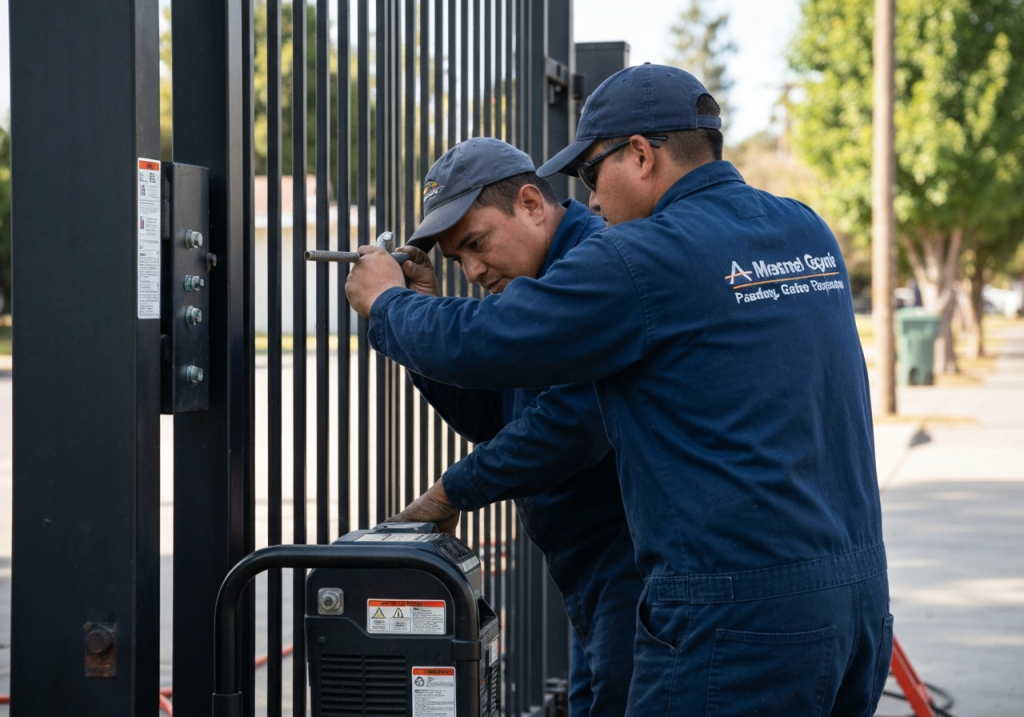
Most automatic gate failures don’t happen without warning – they’re the result of months of skipped maintenance that finally catches up all at once. According to service data from our Gate Repair services across Southern California, roughly 70% of emergency gate calls could have been prevented with a simple seasonal inspection. Pasadena homeowners face a specific combination of challenges: dry Santa Ana wind cycles, occasional hard rains that wash debris into tracks, and UV exposure that degrades rubber seals and lubricants faster than manufacturers typically account for. This guide gives you a complete, actionable maintenance checklist so your gate keeps working reliably year-round – and you know exactly when to stop DIYing and call for backup.
Quick Answer
A proper gate maintenance checklist for Pasadena homeowners covers six core areas: hinge and hardware lubrication, track and roller cleaning, operator motor inspection, safety sensor testing, control board and wiring checks, and entry system (intercom/keypad) servicing. Complete a full inspection every 90 days, with a deeper annual service that includes load testing your motor and recalibrating limit switches. Pasadena’s dry heat and periodic heavy rains make twice-yearly deep cleanings especially important.
Table of Contents
- 1. Hinges, Rollers, and Hardware Inspection
- 2. Track and Ground Clearance Checklist
- 3. Gate Operator and Motor Maintenance
- 4. Safety Sensor and Obstruction Testing
- 5. Wiring, Control Board, and Battery Backup
- 6. Access Control and Entry System Upkeep
- 7. Pasadena Seasonal Maintenance Calendar
- Common Mistakes to Avoid
- When to Call a Professional
- Frequently Asked Questions
Hinges, Rollers, and Hardware Inspection
The mechanical connection points on any gate – swing or slide – take the most stress over time. A gate that sounds like it’s grinding or hesitating on the open cycle has usually been telling you something for weeks before it fully stops. In Pasadena neighborhoods like San Rafael Hills and Bungalow Heaven, we see a lot of ornamental iron swing gates, and the combination of dry air and occasional coastal moisture coming in from the west accelerates oxidation on unpainted hinge surfaces.
Here’s what to check every 90 days:
- Hinge bolts and welded collars: Tighten any bolts that have worked loose. Check welds for hairline cracks – they’re easier to repair early than after the hinge collapses.
- Roller wheels (slide gates): Spin each roller by hand. It should turn smoothly with no flat spots or wobble. A flat-spotted roller puts uneven load on your operator motor and shortens its life.
- Gate post anchoring: Push gently against the gate posts. Any movement in the concrete footing is a structural red flag, especially on properties with hillside grading in the Altadena foothills area.
- Latch and lock mechanism: Manually latch and unlatch. Latches should engage with light, even pressure – not require a shove or a lift.
- Rust and corrosion treatment: Wire-brush any rust spots and apply a rust-inhibiting primer before they eat through the metal. Pasadena’s dry summer air won’t rust iron overnight, but the winter wet season absolutely will if surfaces are compromised.
Apply a silicone-based or lithium grease lubricant (not WD-40, which evaporates too quickly) to all pivot points after cleaning. This single step prevents roughly 40% of hinge-related service calls we handle.
Track and Ground Clearance Checklist
Slide gate tracks are ground-level, which means they collect everything: leaf litter, Jacaranda blossoms in late spring, eucalyptus debris, gravel from driveways, and fine dust that packs into a concrete-like crust over time. A clogged track forces your operator to work 30–50% harder than it was designed to, which burns out motors prematurely. This is one of the most overlooked maintenance tasks we see across Pasadena properties.
Follow these steps to clean and inspect the track on a quarterly basis:
- Disengage the operator using the emergency release so you can move the gate manually. Never clean around a live-powered gate.
- Clear the entire track length with a stiff brush or broom. Remove any debris packed into the channel.
- Flush the track with water from a garden hose if buildup is heavy. In Pasadena, the period after the Santa Ana winds pass in October and November often leaves the worst debris accumulation of the year.
- Inspect for track warping or anchor bolt failure. A track that has lifted or bowed – even a quarter inch – will cause your rollers to jump or bind.
- Check ground clearance on swing gates. Ground settling is common on properties near the Arroyo Seco. If your gate now drags, the posts may have shifted and require re-leveling before the operator can be properly recalibrated.
- Re-engage the operator and run the gate through five full open/close cycles. Listen for any new sounds.
For slide gates, a light film of track lubricant applied after cleaning extends smooth operation significantly. Avoid heavy grease in dusty conditions – it traps debris faster than a clean, lightly lubricated track.
Gate Operator and Motor Maintenance
Your gate operator is the most expensive component in the system – typically $400 to $1,800 for a residential unit depending on the brand and gate weight. Protecting that investment with quarterly attention costs almost nothing. Brands like LiftMaster, FAAC, BFT, and Viking all publish recommended service intervals in their manuals, and most suggest professional inspection annually with owner-level visual checks every three months.
What to check on the operator itself:
- Drive chain or belt tension (slide operators): A chain with more than a half-inch of slack needs adjustment. A too-tight chain is just as damaging – it strains the drive gear.
- Arm and clevis connections (swing operators): Inspect the ram arm connection to the gate and the clevis pin. Any slop or wobble here transfers lateral load to the motor gearbox.
- Limit switch calibration: The gate should stop cleanly in the fully open and fully closed positions without banging or reversing unexpectedly. Linear and Elite operators have digital limit settings; Ghost Controls solar units use a learn-mode calibration that should be re-run after any power interruption.
- Force sensitivity settings: Test by placing firm hand resistance on the gate mid-travel. A properly calibrated gate should stop and reverse within two seconds of meeting resistance. If it keeps pushing, the force setting is too high and is a safety hazard.
- Housing integrity: Pasadena’s UV exposure degrades plastic operator housings over time. Check for cracked covers, which allow insects and moisture into the control board compartment.
Most residential operators in Pasadena are working in ambient temperatures between 55°F and 105°F across the seasons. High-heat days in July and August push motors harder. If your gate moves noticeably slower on 95-degree afternoons, that’s a thermal overload symptom – not just “how it is.”
Safety Sensor and Obstruction Testing
UL 325 compliance requires that all automatic gate operators installed after 1994 include entrapment protection. For most residential gates in Pasadena, that means photoelectric sensors at the base of the gate opening. These sensors are required by code, and they’re also the feature most likely to drift out of alignment without anyone noticing – until the gate closes on a vehicle, a pet, or a person.
Run this safety test every 30 days – it takes under five minutes:
- Align verification: With the gate open, look directly at both sensor heads. The indicator light on the receiver unit should be solid (not blinking). A blinking light means the beam is partially blocked or misaligned.
- Break the beam test: While the gate is closing, place a 2×4 flat on the ground across the sensor beam path. The gate must stop and reverse immediately. If it doesn’t, the sensor system has failed and the gate should be taken offline until repaired.
- Loop detector check (if installed): If your driveway has a buried inductive loop, verify that it correctly detects your vehicles and doesn’t false-trigger on neighboring car traffic.
- Edge sensor inspection (if installed): Contact-type safety edges on the gate face should compress and trigger a stop when pressed with moderate hand pressure.
In Pasadena, we’ve found that sensor alignment issues spike after the first significant rainstorm of the season – water intrusion at the base of posts shifts the sensor brackets. Check alignment every time we get a substantial rainfall event, not just on a fixed quarterly schedule.
Wiring, Control Board, and Battery Backup
Control board failures are the most expensive non-physical repair on an automatic gate – replacement boards for DoorKing, Ramset, or FAAC units can run $200 to $600 or more, and they’re almost always caused by preventable problems: moisture intrusion, rodent damage to wiring, or battery acid leakage from a neglected backup battery.
Annual wiring and electrical inspection checklist:
- Visual wire inspection: Trace all low-voltage wiring from sensors, keypads, and intercoms back to the control board. Look for chewed insulation (rodents are a persistent issue in areas with drought-dry landscaping near the San Gabriel foothills), cracked conduit, or corroded terminals.
- Battery backup test: Disconnect shore power and operate the gate on battery alone. A healthy 12V or 24V backup battery should complete 20–30 full cycles before the low-battery indicator activates. If it struggles after five cycles, replace it. Most backup batteries have a 2–3 year functional life in Pasadena’s heat.
- Terminal connection tightness: Loose terminals are a surprisingly common cause of intermittent gate behavior – the gate works fine in the morning and acts erratically in the afternoon heat when metal expands.
- Ground fault check: Any gate operator in a wet-weather zone should have its ground wire inspected annually. A poor ground causes erratic behavior and can allow dangerous voltage on the gate frame itself.
- Control board visual: Look for any burn marks, swollen capacitors, or evidence of moisture inside the housing. These are non-negotiable replacement triggers.
Access Control and Entry System Upkeep
Your gate’s access system – whether it’s a LiftMaster remote, a DoorKing telephone entry panel, a keypad from Linear, or a video intercom – is the interface your household uses dozens of times a week. It’s also the component most often neglected until it stops working at an inconvenient moment.
Quarterly access system maintenance:
- Keypad cleaning: In Pasadena’s dry conditions, fine dust accumulates in keypad button gaps. Clean with compressed air and a lightly dampened cloth. Avoid spraying water directly onto the unit.
- Remote programming verification: Test all remotes in your household. Walk to the outer edge of your property’s remote range and verify the gate still responds. Range that has shortened by 50% or more often indicates an antenna issue at the operator, not a remote battery problem.
- Intercom audio and camera: Test two-way audio if you have a video intercom. Camera lenses should be cleaned with a microfiber cloth – Pasadena’s dry air carries particulate that fogs lens surfaces over time.
- Access code audit: Once a year, delete old codes for former housekeepers, contractors, or tenants. This is a security discipline issue as much as a maintenance one.
- Cellular or IP connection (smart systems): If your intercom runs on a cellular connection, verify the signal and check for any firmware updates from the manufacturer. Outdated firmware is a common cause of connectivity failures in smart gate systems.
Pasadena Seasonal Maintenance Calendar
Pasadena’s climate doesn’t follow a traditional four-season pattern, but there are distinct service windows that align with local weather patterns. Building your maintenance schedule around these windows maximizes effectiveness.
- January–February (Post-Rainy Season Check): Inspect tracks and ground clearance after winter rain events. Check sensor alignment and verify no water has entered control board housings. Test battery backup – cold nights reduce battery capacity.
- April–May (Pre-Summer Prep): Lubricate all mechanical components before temperatures climb. This is the best window for a full professional service call before the heat stress of summer. Jacaranda bloom season means heavy debris – clean tracks weekly during peak bloom in late May and early June.
- July–August (Heat Monitoring): Monitor gate speed and motor temperature. If the operator has a thermal overload feature, it may trigger on 100°F+ afternoons. This is not a malfunction – but repeated triggering indicates the motor is undersized or overworked.
- October–November (Santa Ana Season Prep): The Santa Ana winds that push through the San Gabriel Valley carry significant debris loads. Clean tracks before and after major wind events. Check that operator housing lids are fully latched – wind-driven dust inside a control board compartment is a real failure risk.
Common Mistakes to Avoid
- Using WD-40 as a long-term lubricant: WD-40 is a water displacer, not a lubricant, and it evaporates quickly in Pasadena’s dry heat. It also attracts dust. Use white lithium grease or a silicone-based spray on all mechanical components.
- Ignoring slow gate movement: A gate that’s gradually getting slower isn’t “just getting older” – it’s signaling a specific mechanical or electrical problem. Left unaddressed, slow operation eventually becomes no operation, usually at the worst possible time.
- Skipping sensor tests after landscaping work: Any time a gardener or landscaping crew works near the gate, soil and debris get displaced. Sensor alignment should be verified the same day. We’ve seen gates in the Hastings Ranch area that were unknowingly operating with disabled sensors for weeks after a landscaping project.
- Replacing batteries with the wrong spec: Backup batteries are not universal. Using an undersized amp-hour battery in a FAAC or Viking operator causes premature failure and, in some cases, board damage. Always match or exceed the manufacturer’s battery specification.
- Forcing a gate that won’t close: Manually forcing a gate that the operator can’t close often bends the drive arm or strips the gearbox. Disengage the operator with the emergency release and diagnose the obstruction before re-engaging.
- Painting over sensor lenses or receiver windows: During exterior repaints, photoelectric sensor faces and remote receiver antennas sometimes get coated. Even a thin layer of paint can reduce sensor range by 70% or block the beam entirely.
- Delaying repairs after a vehicle strike: Gates hit by vehicles – even low-speed impacts – often have hidden structural damage to posts or underground anchoring. Operating a structurally compromised gate accelerates wear on every connected component.
When to Call a Professional
Some gate maintenance tasks are genuinely within reach for a careful homeowner. Others carry real safety risk or require specialized tools and diagnostic equipment. If you’re unsure who to call, read How to Hire a Gate Repair Contractor in Pasadena: A Step-by-Step Guide. Call a professional when you notice any of the following:
- The gate fails the force-reversal safety test – this is a liability and safety emergency, not a “fix it next month” situation.
- You see burn marks, melted wiring, or smell electrical burning from the operator housing.
- The gate has been struck by a vehicle and the post or frame shows any visible bend or displacement.
- The control board displays error codes you can’t resolve with the manufacturer’s manual.
- The gate moves erratically – reversing for no reason, stopping mid-travel, or refusing to respond to remotes despite good batteries.
- Any hinge weld has cracked or a pivot bolt has sheared.
Absolute Gate Repair Solutions offers free estimates throughout Pasadena and surrounding areas. William Jones and our team have been diagnosing and repairing gates across Pasadena since 2015, with 208 verified reviews averaging 4.9 stars. Call us at (866) 827-7631 – we’ll give you an honest assessment of what your gate actually needs.
Frequently Asked Questions
How often should I service my automatic gate in Pasadena?
You should perform a basic visual inspection monthly and a full mechanical and electrical check every 90 days. Schedule a professional service at least once a year – ideally in April or May before Pasadena’s summer heat puts additional load on motors and control boards. Properties with high daily cycle counts (10+ opens per day) benefit from a professional inspection every six months.
What lubricant should I use on my gate’s hinges and rollers?
Use white lithium grease or a silicone-based spray lubricant on hinges, rollers, and pivot points. Avoid petroleum-based sprays like WD-40 for anything more than a temporary fix – they evaporate quickly in Pasadena’s dry climate and leave residue that attracts dust. For chain-driven slide operators, use a dedicated chain lubricant, not general-purpose grease.
Why does my gate work fine in the morning but act up in the afternoon?
Afternoon gate problems in Pasadena are most often caused by one of three things: thermal overload on the motor during high-temperature days, a loose terminal connection that expands with heat and loses contact, or a backup battery that’s weakened and can’t maintain voltage as ambient temperature rises. Have a technician check all three before replacing the operator, which is a common but expensive misdiagnosis.
Do I need a permit to repair or replace a gate operator in Pasadena?
Replacing a gate operator in kind – same location, same type of gate – generally does not require a permit from the City of Pasadena. For more complex projects, see Gate Repair Permits, Codes & Inspections in CA: What You Need to Know. However, if you’re relocating a gate, adding electrical service to a previously non-powered gate, or installing a new gate structure, permits and inspection are typically required. Always verify with the Pasadena Building and Safety Division for your specific scope of work before starting.
How long do residential gate operators typically last?
A well-maintained residential gate operator from a quality brand like LiftMaster, FAAC, or BFT typically lasts 10 to 15 years under normal residential use. Operators in high-cycle environments – such as multi-family properties or homes with frequent deliveries – may need replacement in 7 to 10 years. The single biggest factor in longevity is consistent lubrication and keeping the gate’s mechanical components in good alignment so the motor isn’t overworking.
What’s the most common gate repair we see in Pasadena?
The most common repair we handle across Pasadena is debris-caused slide gate track obstruction, followed closely by failed or misaligned photoelectric safety sensors. Both are almost entirely preventable with the quarterly cleaning and testing steps in this guide. The third most common call is battery backup replacement – Pasadena’s heat is hard on sealed lead-acid batteries, which typically need replacement every two to three years regardless of use.
The Bottom Line
For more guides & resources, visit our blog. A reliable automatic gate doesn’t happen by accident. It’s the result of consistent, straightforward maintenance that catches small problems before they become expensive ones. For Pasadena homeowners, that means working with – not against – the local climate: cleaning tracks after Santa Ana wind events, testing sensors after winter rains, and monitoring motor performance during summer heat spikes. The checklist in this guide takes less than an hour per quarter to complete. That’s a small investment to protect a system that costs $1,500 to $5,000 or more to replace. Stay ahead of it, and your gate will stay out of your way.
Written by the team at Absolute Gate Repair Solutions, serving Pasadena since 2015.