
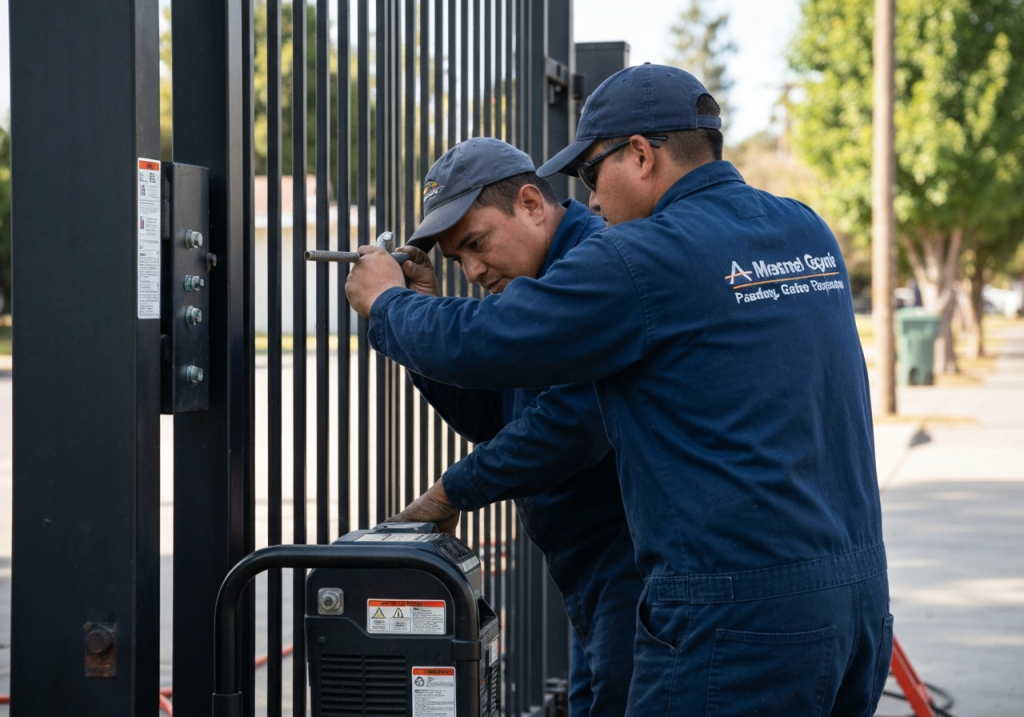
Last updated July 12, 2026
The Complete Guide to Gate Repair in Pasadena
Most Pasadena homeowners don’t think about their gate until it stops working – usually at the worst possible moment, like a Sunday evening with groceries in the car. Here’s the surprising part: nearly 60% of gate failures we diagnose are caused by deferred maintenance on a single component that costs under $40 to replace proactively. This guide – along with our Gate Repair services – walks you through every major aspect of gate repair – from identifying common failure points and understanding Pasadena’s unique climate effects on gate hardware, to knowing which brands hold up best locally and when a DIY fix is enough versus when you need a licensed technician on-site.
Quick Answer
Gate repair in Pasadena typically covers issues with operators, hinges, springs, circuit boards, safety sensors, and access control systems. Most residential gate repairs cost between $150 and $650 depending on the component, with operator replacements running $800–$1,800 installed. Pasadena’s dry Santa Ana wind seasons and periodic heavy winter rains accelerate wear on gate hardware faster than the national average, so annual maintenance is strongly recommended.
Table of Contents
- Why Pasadena’s Climate Is Harder on Gates Than You Think
- The Most Common Gate Problems We See in Pasadena
- Types of Gates and How Repair Needs Differ
- Gate Operator Brands: What’s Worth Repairing vs. Replacing
- What You Can Fix Yourself vs. What Requires a Professional
- Gate Repair Costs in Pasadena: What to Expect
- A 7-Step Annual Maintenance Routine for Pasadena Gates
- Permits and Code Considerations in Pasadena
Why Pasadena’s Climate Is Harder on Gates Than You Think
Pasadena sits at the base of the San Gabriel Mountains, and that geography creates a climate that’s genuinely hard on metal hardware. During Santa Ana wind events – which typically run September through November – airborne grit and debris work their way into hinges, limit switches, and track channels. We’ve pulled gate tracks in Altadena-adjacent neighborhoods that looked like sandpaper had been run through them after a single bad wind season.
Then there’s the winter wet season. Pasadena’s rainfall is sporadic but intense, and gate posts set in older concrete footings absorb water that causes micro-shifts in post alignment. A gate that swings cleanly in October can be dragging its bottom rail by February. UV exposure is the third factor – Pasadena averages 284 sunny days per year, and direct sun degrades rubber seals on hydraulic operators and causes plastic sensor housings to become brittle within 3–5 years.
Neighborhoods with mature tree canopy, like San Rafael Hills and South Pasadena’s border areas, face an additional problem: organic debris builds up in sliding gate tracks and accelerates corrosion at the gear rack interface. Understanding these local conditions isn’t just trivia – it directly shapes which repair approach and which hardware will actually last in this specific environment.
The Most Common Gate Problems We See in Pasadena
After more than 11 years and thousands of service calls across Pasadena and the surrounding foothill communities, the failure patterns are remarkably consistent. Here are the problems we diagnose most often, ranked by frequency:
- Operator motor failure: Usually presents as the gate humming but not moving, or moving only partway. Often caused by a capacitor failure rather than the motor itself – a $35–$60 fix if caught early.
- Limit switch drift: The gate overshoots or stops short of fully open or closed. Santa Ana wind vibration is a frequent culprit in Pasadena properties.
- Safety sensor misalignment: The gate reverses immediately or refuses to close. Sprinkler overspray and ground settlement are the main causes locally.
- Hinge wear and post lean: Swing gates in older Pasadena estates – particularly in the historic Madison Heights and Bungalow Heaven areas – frequently show post lean from decades of soil movement.
- Circuit board failure: Power surges during summer storms kill logic boards. We see a spike in board replacements every July–August.
- Spring failure on slide gates: In Natomas-adjacent commercial properties and newer Pasadena developments, improperly tensioned springs fail within 2–4 years without lubrication.
- Battery backup degradation: Sealed lead-acid batteries in most residential operators lose capacity after 2–3 years in Pasadena’s heat. The gate works fine on AC but fails during outages.
Types of Gates and How Repair Needs Differ
Not all gates fail the same way, and repair strategies vary significantly by gate type. Here’s a breakdown of what to expect for each major category:
Sliding Gates
Sliding gates run on a bottom track (or a cantilever roller system for track-free designs). Track-mounted sliders in Pasadena accumulate debris rapidly during fire season. The most common repairs are track cleaning, roller replacement, and gear rack re-alignment. Cantilever gates avoid the track debris problem but put more stress on the rollers and require precise counterbalancing – if your gate has started swaying during operation, the rollers need inspection immediately.
Swing Gates
Single and dual swing gates are the most common configuration in Pasadena’s residential neighborhoods, especially in properties built before 1990. Repair needs center on hinge condition, post plumb, and arm bracket integrity. A swing gate operator working against a misaligned hinge will burn out its motor 2–3 times faster than normal. We always check post plumb before touching the operator on a swing gate call.
Vertical Pivot and Bi-Fold Gates
Less common but found in higher-end Pasadena properties and some commercial applications on Foothill Boulevard and Colorado Boulevard corridors. These gates have specialized hardware that most general handymen aren’t familiar with – repair almost always requires a specialist.
Gate Operator Brands: What’s Worth Repairing vs. Replacing
Brand matters enormously when deciding whether to repair or replace an operator. Here’s an honest assessment of what we commonly encounter in Pasadena:
- LiftMaster (and its commercial-grade Chamberlain Group siblings): Extremely common in residential Pasadena. Parts are widely available and cost-effective. Units over 12 years old with board failures are borderline – repair only if the motor and mechanical components are clean.
- FAAC: Italian-engineered hydraulic operators that we see on higher-end Pasadena estates. Excellent longevity – a well-maintained FAAC unit can run 20+ years. Hydraulic fluid service every 3–5 years is the key maintenance item. Absolutely worth repairing in most cases.
- BFT: Another Italian brand with strong reliability. Circuit boards can be expensive, but the mechanical components are built to last. We recommend BFT for Pasadena’s dusty wind conditions because of its sealed motor design.
- Linear: Common in older Pasadena installations from the late 1990s and early 2000s. Parts availability has declined. If the board is dead on a Linear unit over 15 years old, replacement is usually the smarter economic choice.
- Viking: Popular in commercial Pasadena applications. Heavy-duty construction, but control boards are proprietary – repair costs are higher than residential brands.
- Ghost Controls: Solar-powered and battery-operated units increasingly popular in hillside Pasadena properties without easy power access. Simple to repair when problems are mechanical, but the integrated solar controller can be a single point of failure.
- DoorKing: Primarily an access control brand but paired with operators on many Pasadena multi-unit properties. The keypads and telephone entry systems need re-programming more than mechanical repair.
- Elite and Ramset: Often found in older commercial and multi-family Pasadena installations. Ramset in particular has been discontinued, so parts sourcing for repairs requires a specialist with an existing inventory.
What You Can Fix Yourself vs. What Requires a Professional
We believe in giving homeowners honest information. Some gate issues are genuinely DIY-able. Others are safety risks or technically complex enough that a mistake costs more than the repair would have.
Tasks Most Homeowners Can Handle
- Cleaning the gate track or roller channel with a stiff brush and compressed air
- Re-programming a remote transmitter or keypad code (refer to your operator’s manual)
- Replacing a dead battery backup (sealed lead-acid units typically use standard sizes)
- Re-aligning photo eye sensors by adjusting the mounting bracket until the indicator light is steady
- Applying dry lubricant (never WD-40) to hinges, rollers, and drive chains
Tasks That Require a Licensed Technician
- Any work involving the operator’s internal wiring or logic board
- Gate post re-setting or footing work (requires proper concrete work and alignment tools)
- Spring tension adjustment on commercial slide gates (serious injury risk if released incorrectly)
- Hydraulic fluid service on FAAC or BFT operators
- Installing or re-configuring access control systems connected to a building’s network
- Any electrical work connecting an operator to line voltage (requires a licensed electrician in California)
Gate Repair Costs in Pasadena: What to Expect
Pasadena’s labor market sits slightly above the Los Angeles county average, and that’s reflected in gate repair pricing. Here’s a realistic breakdown of what repairs cost in this specific market as of 2025–2026:
- Service call / diagnostic fee: $75–$125 (often waived if you proceed with repair)
- Photo eye / safety sensor replacement: $120–$200 including parts and labor
- Control board replacement: $250–$550 depending on brand (LiftMaster boards run lower; Viking and BFT run higher)
- Motor or capacitor replacement: $180–$400
- Hinge replacement (per hinge): $95–$175
- Complete operator replacement – residential: $800–$1,400 installed
- Complete operator replacement – commercial: $1,400–$3,200 installed depending on gate weight and duty cycle
- Post re-setting (concrete and labor): $400–$900 depending on post size and soil conditions
- Annual maintenance service: $150–$250 for a full lubrication, adjustment, and safety check
One Pasadena-specific note: if your property is in a homeowners association – common in Hastings Ranch, Chapman Woods, and several other established Pasadena communities – confirm whether gate repairs require HOA pre-approval before scheduling work. Some associations have preferred vendors or required permit pull procedures that can affect your timeline; see our Gate Repair Permits, Codes & Inspections in CA: What You Need to Know for details.
A 7-Step Annual Maintenance Routine for Pasadena Gates
The single best investment you can make in a gate system is a consistent annual maintenance routine. This is especially true in Pasadena, where wind, UV, and seasonal rain create above-average wear conditions. Follow these steps every 12 months – ideally in late spring before the dry season begins – or use our Gate Repair Maintenance Checklist for Pasadena Homeowners:
- Clean the track or roller path. Use a stiff-bristle brush to remove all debris, then blow out remaining dust with compressed air. In Pasadena’s fire season, this step alone prevents the majority of sliding gate failures.
- Inspect and lubricate all hinges. Apply a dry lubricant (silicone or PTFE-based, not petroleum-based grease) to every hinge point. If you feel grinding or see rust pitting, replace the hinge – don’t just lubricate over corrosion.
- Check gate post plumb. Use a level on both the vertical and horizontal plane. More than 1/8″ of lean over a 4-foot span needs a professional evaluation before it gets worse.
- Test all safety reversals. Place a 2×4 flat on the ground in the gate’s path and run a close cycle. The gate must reverse on contact. This is a California safety requirement, not optional.
- Inspect the drive chain or belt. A loose or dry chain is the fastest path to operator damage. Tighten and lubricate per the manufacturer spec – typically 1/2″ of slack at the midpoint.
- Test the battery backup. Disconnect AC power and cycle the gate 5–6 times. If the gate slows noticeably or fails to complete a cycle, the battery needs replacement. In Pasadena’s heat, expect 2–3 year battery life.
- Verify all access control functions. Test every remote, keypad code, and vehicle loop detector. Re-program any codes that are shared with former residents or service vendors.
Permits and Code Considerations in Pasadena
Pasadena falls under both the City of Pasadena’s municipal code and California state requirements for automated gate safety. Here’s what property owners need to know before starting any gate work:
When a permit is required: In Pasadena, a building permit is generally required when installing a new gate operator, replacing an existing operator with a different model or voltage configuration, or making structural changes to gate posts or the gate itself. Like-for-like operator replacements may qualify for permit exemption, but it’s worth confirming with the City of Pasadena Building Department at (626) 744-6777 before assuming you’re exempt.
California Senate Bill 969 (Automated Gate Safety): Any automated gate serving a residential property in California must comply with UL 325 safety standards, which mandate entrapment protection devices – including photo eye sensors, edge sensors, or constant-pressure controls. If your gate lacks these, you’re not compliant. During any repair or replacement, a licensed contractor is legally required to bring the system into compliance.
HOA and historic district considerations: Pasadena has several designated historic districts where exterior modifications – including gate changes – require approval from the City’s Historic Preservation Commission. If your property is in the Bungalow Heaven Landmark District or the Pasadena Heritage neighborhoods, check before you change any gate that’s visible from the street.
Common Mistakes to Avoid
- Using WD-40 on hinges or chains: WD-40 is a water displacer, not a lubricant. It attracts dust and dries out, leaving your hinges worse than before. In Pasadena’s dusty climate, this accelerates wear dramatically. Use a dedicated dry lubricant or white lithium grease instead.
- Ignoring a slow gate: A gate that’s “working but slow” is telegraphing a motor, capacitor, or binding problem. Continuing to run it under strain shortens the operator’s life from years to months. Address slowness the same week you notice it.
- Buying a replacement operator without measuring gate weight and width first: Operators are rated by gate weight and width. We’ve seen homeowners buy undersized operators for their heavy iron Pasadena estate gates, resulting in failures within 18 months.
- Skipping the safety sensor test after any repair: Any time a gate is worked on – even just lubrication – run a full safety reversal test before considering the job done. This is a legal requirement in California and a basic liability issue.
- Re-programming access codes after a repair but not after a tenant turnover: In Pasadena’s active rental market, old gate codes are a real security issue. Change all keypad codes and remote pairings every time a resident with access moves out.
- Attempting to adjust spring tension without proper training: Torsion springs on heavy slide gates store significant energy. An improper release can cause serious injury. This is not a YouTube tutorial job – it’s a professional-only task.
- Assuming all gate technicians are licensed: In California, gate operator installation work involving line voltage must be performed by a licensed C-10 electrical contractor or a general contractor with appropriate licensing. Always ask for the contractor’s license number and verify it at the CSLB website before any electrical gate work.
When to Call a Professional
Call a gate repair professional immediately if your gate is stuck in the open position (a security risk), making grinding or metal-on-metal sounds, failing its safety reversal test, sparking or showing any sign of electrical burning smell, or if a vehicle has made contact with the gate. These aren’t watch-and-wait situations.
Also call a pro when a DIY adjustment doesn’t hold – if you’ve re-aligned sensors twice and the problem returns, something structural is shifting. And any time post lean, concrete damage, or significant hinge corrosion is visible, get a professional assessment before the problem escalates to a gate collapse.
William Jones and the team at Absolute Gate Repair Solutions offer free on-site estimates throughout Pasadena – no obligation, no pressure. Call us at (866) 827-7631 and we’ll have a technician at your property, typically within 24 hours.
Frequently Asked Questions
Most gate repairs in Pasadena are completed in a single visit of 1–3 hours. Exceptions include post re-setting (concrete cure time adds a day) and specialty parts orders for older or discontinued brands like Ramset – those can take 3–7 business days for parts sourcing.
The average gate repair cost in Pasadena runs between $150 and $650 for most common issues – sensor replacement, board swaps, hinge work, or chain adjustments. Full operator replacements run $800–$1,800 installed for residential units. Getting a specific estimate before approving work is always the right move.
You can handle basic maintenance tasks yourself – cleaning, lubrication, remote re-programming, and battery replacement. However, any work involving line-voltage wiring in California must be performed by a licensed contractor. Additionally, any repair that affects safety compliance (sensor function, reversal behavior) should be verified by a professional before the gate is put back into regular use.
Gates in Pasadena should be professionally serviced once per year, ideally in spring before the dry, dusty summer season. Properties near hillside areas or with mature tree canopy – like parts of San Rafael Hills or Linda Vista – may benefit from a mid-season track cleaning as well, given the volume of organic debris those locations accumulate.
FAAC and BFT hydraulic operators consistently show the longest service life in our experience – 15 to 20+ years with proper maintenance. LiftMaster is the best value for most Pasadena residential applications given parts availability and price. For solar-powered hillside installations, Ghost Controls has proven reliable with proper battery management.
Pasadena generally requires a permit for new gate operator installations and for replacements that change the electrical configuration. Like-for-like replacements may be exempt, but you should confirm with the City of Pasadena Building Department before starting work. Failing to pull a required permit can complicate future property sales and insurance claims.
The Bottom Line
Gate repair in Pasadena isn’t one-size-fits-all. The local climate – wind, UV, and intense seasonal rain – creates wear patterns that differ from inland or coastal markets. Knowing your gate type, your operator brand’s repairability, and which tasks genuinely require a licensed technician can save you hundreds of dollars and weeks of security headaches. Annual maintenance is the single best investment you can make, and you can find more guides & resources on our blog. And when something goes wrong that’s beyond a DIY fix, getting a professional on-site quickly prevents a minor repair from becoming a full replacement. William Jones and our team are here when you need us.
Written by the team at Absolute Gate Repair Solutions, serving Pasadena since 2015.